What Is Salesforce? A Plain-English Guide for Mortgage Ops Teams
Most mortgage ops teams hear "Salesforce" before anyone explains what it actually does, so they end up guessing in a meeting instead of asking. This guide breaks it down in plain English: what Salesforce is, what Sales Cloud, Service Cloud, and Financial Services Cloud actually mean for a lending team, what it costs as of 2026, and why a generalist CRM built for every industry usually needs heavy customization before it understands a 1003 or talks to a loan origination system.
It's written for brokers, processors, and ops leads weighing Salesforce CRM against a mortgage-native alternative. Real specifics instead of theory: compliance workflows, LOS integration costs, referral tracking, and the everyday friction of a processor retyping the same loan three times before lunch, plus where MoserBus fits once a generalist platform stops making sense for a lean mortgage team.
Somebody on your team, probably your ops lead or a broker who just left a bank, mentioned Salesforce in a meeting. Now you're the one googling it at 9pm trying to figure out what it actually is before the next call.
Here's the short version: Salesforce is the world's most widely used customer relationship management platform, software that stores every contact, deal, and interaction your business has, then automates the busywork around them. It was built for sales teams in general, not mortgage teams specifically, and that gap matters more than most vendors will tell you.
This guide breaks down what Salesforce is, what it does, what it costs, and whether it's the right fit for a mortgage brokerage or processing shop, or whether you need something built for lending from the ground up.
What Is Salesforce, Exactly?
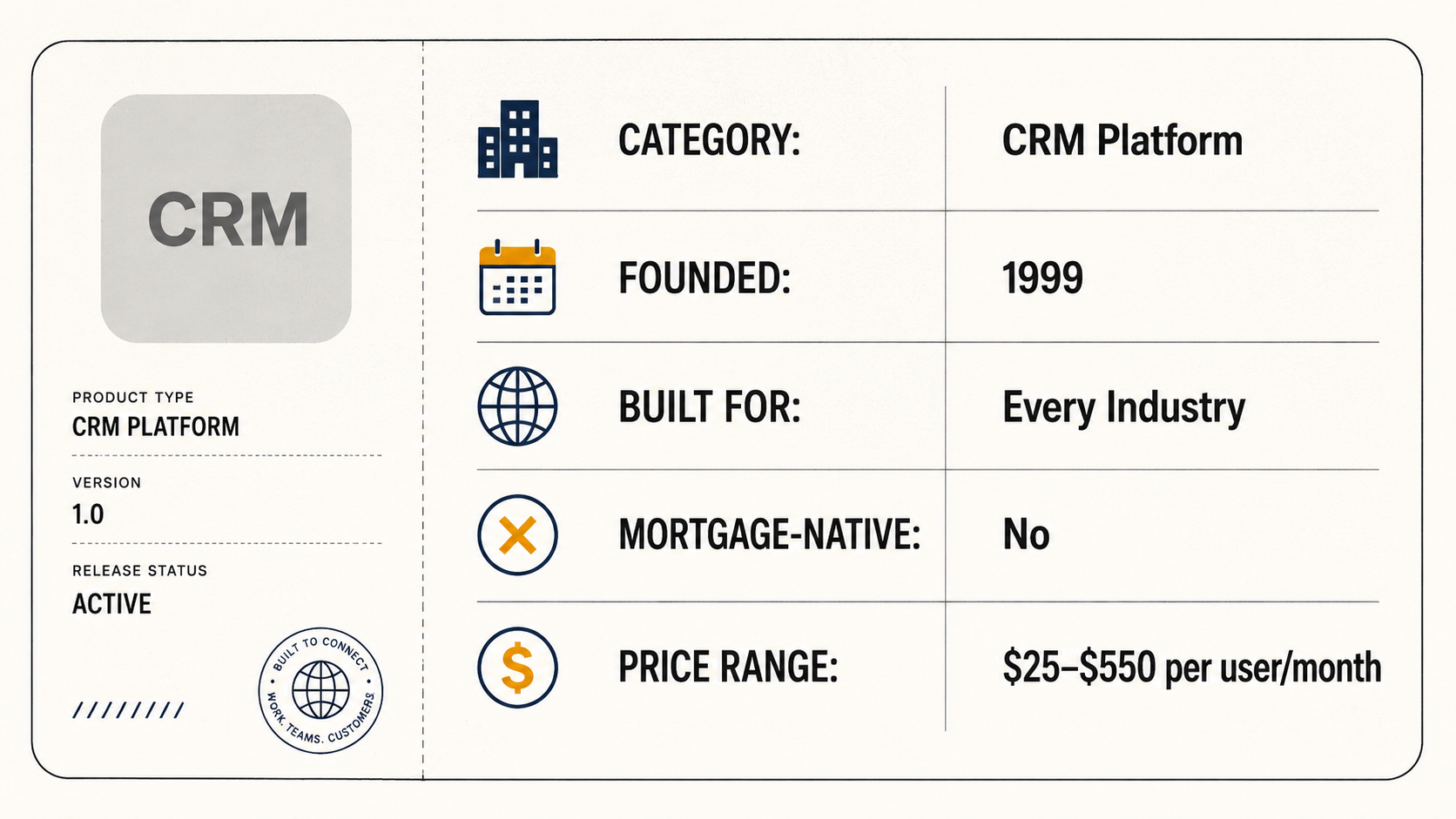
Salesforce is a cloud-based CRM company founded in 1999 by Marc Benioff, built on the idea that business software shouldn't live on a server in your office closet. Everything runs in a browser instead. You log in, your data is there, and nothing you personally installed can crash it.
At its most basic, Salesforce is a database for your business relationships. Every lead, every borrower, every referral partner, every email and phone call gets logged against a record. Salespeople call this having a single source of truth, which is really just a fancy way of saying nobody has to ask "wait, who talked to this person last?" in a Monday pipeline meeting.
Salesforce has grown into a company worth hundreds of billions of dollars and now owns Slack, Tableau, and MuleSoft, among others. But the piece loan officers and processors actually touch day to day is Sales Cloud, recently rebranded as Agentforce Sales, the CRM engine everything else plugs into.
What Does Salesforce Do?
Strip away the marketing language and Salesforce does four things: it stores information, tracks where a deal sits in your pipeline, automates repetitive tasks, and reports on what's happening across your team.
For a typical sales org, that looks like a rep logging a call, the system automatically scheduling a follow-up task three days later, and a manager pulling a dashboard that shows how many deals are sitting in "under contract" versus how many are closing this month.
None of that is mortgage-specific. Salesforce doesn't know what a 1003 is out of the box. It doesn't understand rate locks, doesn't talk to your LOS, and can't tell a pre-approval from a clear-to-close unless somebody builds that logic in by hand. That's not really a knock on the platform. It's just what happens when a tool is designed to serve every industry from software companies to car dealerships to nonprofits, all at once.
Salesforce's Core Products, Translated for Mortgage Ops
Salesforce sells its CRM in modules it calls "Clouds." A handful come up often enough in mortgage conversations to be worth knowing by name.
Sales Cloud is the core CRM: contacts, leads, opportunities, pipeline stages. This is the piece most brokerages license first, and often the only one they end up using.
Service Cloud handles support tickets and case management, useful if your team fields a high volume of borrower questions after close.
Marketing Cloud runs email and SMS campaigns at scale. Some larger lenders use it for drip nurture sequences aimed at past clients and referral agents.
Financial Services Cloud is Salesforce's industry-specific layer, built for banks, wealth managers, and lenders. It adds some mortgage-adjacent objects, like household and financial account tracking, on top of Sales Cloud. But it comes at enterprise pricing and still needs a certified implementation partner to configure for lending workflows.
Then there's Agentforce, Salesforce's AI agent layer, which we covered in more depth in Salesforce Agentforce Explained: What It Means for Mortgage Ops Automation. Short version: it can automate borrower-facing conversations, but it's an add-on cost stacked on top of an already expensive base license.
What Is Salesforce Used for in a Mortgage Shop?
On paper, a mortgage brokerage using Salesforce would run leads through it from first contact to funded loan. In practice, most shops end up using it for a narrower slice: tracking referral partners, logging loan officer activity, and giving branch managers a pipeline view across multiple LOs.
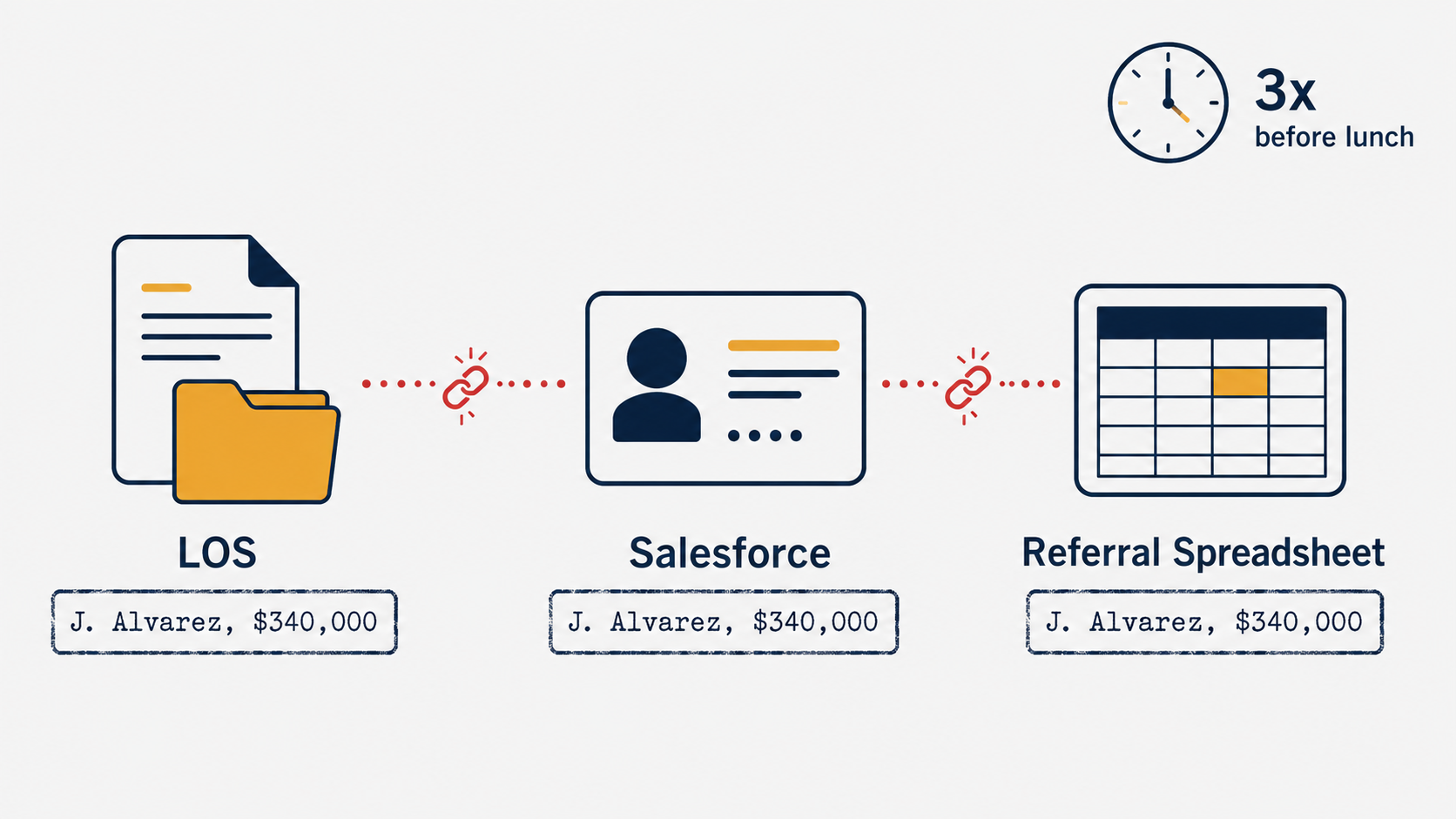
Picture a processor pulling a borrower's file. The 1003 lives in the LOS. The referral agent's contact info lives in Salesforce. The rate sheet lives in a spreadsheet somebody emails around every morning. None of those three systems talk to each other unless somebody paid for custom integration work, so the processor retypes the same borrower name and loan amount three separate times before lunch.
That's the pattern that shows up again and again in mortgage ops. Salesforce is genuinely good at what it does, but "what it does" was never built around a loan file. Teams that get real value out of it usually have an in-house Salesforce admin, or they pair it with a mortgage CRM software layer that already has lending logic built in, to bridge that gap.
Salesforce CRM vs. a Mortgage-Built CRM
If you've heard a processor or ops manager say Salesforce "wasn't built for us," they're not wrong, and they're not alone. Salesforce CRM is a generalist platform competing in a category with millions of business customers across every vertical imaginable. Being the biggest CRM in the world doesn't automatically make it the right CRM for a twelve-person mortgage team.
The gap tends to show up in three places. First, compliance: RESPA, TILA, and state licensing rules aren't native to Salesforce, so every disclosure trigger and audit trail has to be custom-built from scratch. Second, LOS integration: connecting Salesforce to Encompass, Calyx, or LendingPad usually means a third-party connector or a developer on retainer. Third, cost of change: adding one custom field can mean filing a ticket with your Salesforce admin instead of flipping a setting yourself.
We've written before about how traditional CRMs fail loan officers for exactly this reason, and it's worth a read alongside this one if you're weighing your options. A mortgage-native platform starts with the loan file, the referral relationship, and the compliance requirement already built in, so you're not paying a consultant to teach a generalist tool the mortgage business from scratch.

What Does Salesforce Cost?
Salesforce pricing changes often enough that any number you read online, including this one, is worth double-checking against Salesforce's own site before you budget around it. As of mid-2026, Sales Cloud runs across five tiers: a free plan capped at two users, a Starter tier around $25 per user per month, Pro around $100, Enterprise around $175, and Unlimited around $350, with the AI-heavy Agentforce 1 tier reaching as high as $550 per user per month.
Most growing sales teams land on Enterprise, since Starter and Pro cap out on automation and reporting fast. And that's before implementation. A real Salesforce build-out for a lending team, one that handles LOS integration and compliance logic, commonly runs tens of thousands of dollars in consulting fees on top of the licenses, billed separately from whatever number the sales rep first quoted you.
None of that makes Salesforce a bad company or a bad product. It's genuinely capable. It's just priced and built for teams with the budget and headcount to configure it, and that describes a fraction of mortgage shops.
Where Salesforce Fits, and Where It Doesn't
Salesforce makes sense for large lenders with a dedicated IT or RevOps function, multiple business lines beyond mortgage, and the budget for ongoing customization. If that's your shop, Financial Services Cloud paired with a strong implementation partner can genuinely work well.
For everyone else, the math gets harder to justify. A small brokerage or processing company is usually better served by a loan origination system paired with a CRM that already speaks mortgage, rather than assembling that functionality inside a generalist platform one integration at a time. If you want to see how the mortgage-specific options stack up against each other, we broke it down in the best mortgage CRM software for 2026.
Frequently Asked Questions
Is Salesforce a CRM? Yes. Salesforce is the company; its core product, Sales Cloud (recently rebranded Agentforce Sales), is the CRM itself. Most people use "Salesforce" and "Salesforce CRM" interchangeably, and that's fine.
Is Salesforce good for mortgage companies? It can work well for large lenders with in-house technical support and budget for custom development. Smaller brokerages and processing shops usually get more value from a mortgage-specific CRM that already includes LOS integration and compliance workflows out of the box.
What is Salesforce used for besides sales? Beyond pipeline management, businesses use Salesforce for customer service through Service Cloud, marketing automation through Marketing Cloud, and, increasingly, AI-driven customer interactions through Agentforce.
How much does Salesforce cost for a small mortgage team? Licenses alone start around $25 per user per month and climb past $350 at the tiers most sales teams actually end up needing. Implementation and integration costs, especially for connecting to a loan origination system, typically add far more than the license fee itself.
Is Salesforce hard to learn? The basic interface, logging calls and updating deal stages, isn't difficult. The learning curve shows up in configuration. Building custom fields, automations, and reports usually requires a trained admin, which is why many small teams either outsource that work or choose a purpose-built alternative instead.
The Bottom Line
None of this makes Salesforce a bad platform. It's a big, general-purpose tool built for every industry, which means a mortgage team ends up doing customization work that a lending-specific product already did for you.
If you're weighing that build-versus-buy decision, MoserBus was built the other way around, mortgage workflows first, so your processors aren't retyping the same loan three times before lunch. Reach out for a walkthrough and see what a mortgage-native CRM looks like next to the tool you were about to sign a two-year contract for.