Why Traditional CRMs Fail Loan Officers (And What Actually Works in 2026)
Most loan officers aren't losing deals because of bad leads. They're losing them because their CRM wasn't built for mortgage workflows.
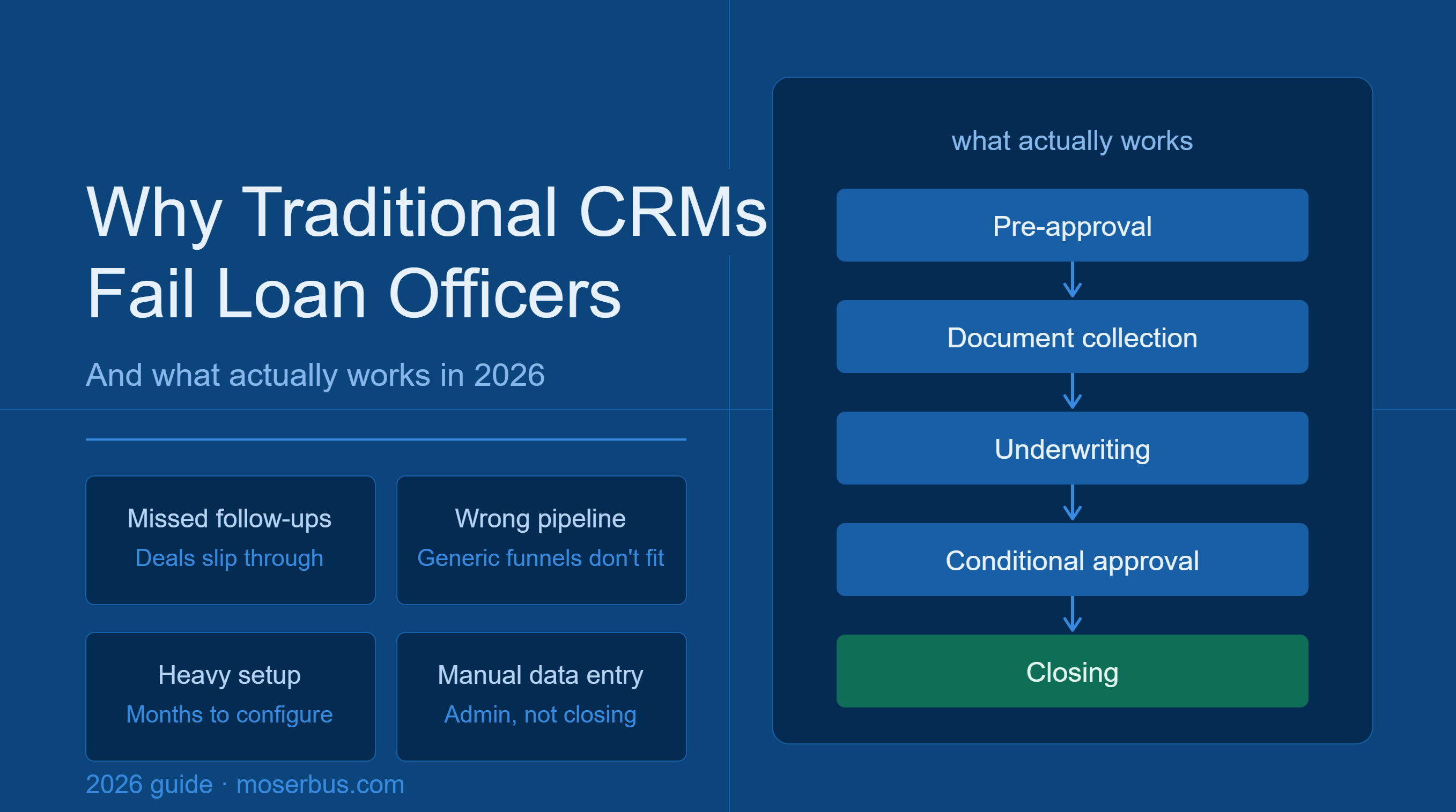
Generic platforms use simple sales funnels. Mortgage doesn't work like that, there's pre-approval, document collection, underwriting, conditional approval, and closing, each with its own follow-up timing. When the pipeline doesn't reflect that, deals slip through.
AI-powered mortgage CRMs fix this by automating follow-ups by deal stage and giving loan officers real visibility into what needs attention. Less admin, more closing.
Introduction
Most loan officers don’t lose deals because of bad leads.
They lose them because of missed follow-ups, messy pipelines, and systems that don’t match how mortgage deals actually work.
And in many cases, the CRM is part of the problem, not the solution.
What Is a Mortgage CRM?
A mortgage CRM is a system designed to help loan officers and brokers:
·
Manage leads and borrower relationships
·
Track loan progress through different stages
·
Automate follow-ups and communication
· Improve conversion rates and response time
But here’s the catch:
👉 Not all CRMs are built for mortgage workflows.
Common Mortgage CRM Problems (Quick Summary)
Most loan officers using a CRM experience at least one of these:
·
Leads not followed up on time
·
Pipeline stages that don’t match real loan
progress
·
Too much manual data entry
·
Overcomplicated setup and workflows
· Lack of visibility into deal status
If this sounds familiar, the issue may not be your process — it may be your CRM.
The Core Problem: CRMs Weren’t Built for Mortgage Workflows
Most CRM platforms were originally designed for:
·
General sales teams
·
Multi-industry use cases
· Flexible, customizable pipelines
While that flexibility sounds useful, it often creates friction for mortgage professionals.
Instead of simplifying work, these systems require:
·
Constant adjustments
·
Manual updates
· Workarounds to fit real processes
Many teams using popular CRM platforms still experience these challenges — not because the tools are bad, but because they weren’t designed for this specific workflow.
Where Existing CRM Tools Fit In
Today, mortgage teams often rely on a mix of tools, including:
·
General-purpose CRMs for flexibility and
customization
·
Marketing-focused platforms for lead nurturing
·
Mortgage-specific systems designed around
industry workflows
· All-in-one tools combining CRM and automation
Each approach has its strengths depending on how a team is set up.
However, challenges often arise when these systems don’t fully align with the day-to-day workflow of managing loans.
4 Reasons Traditional CRMs Fail Loan Officers
1. Pipeline Structures Don’t Match Real Loan Stages
Mortgage workflows are not simple sales funnels.
They include:
·
Pre-approval
·
Document collection
·
Underwriting
·
Conditional approval
· Closing
Generic pipelines often don’t map cleanly to this process, leading to:
·
Confusion across stages
·
Duplicate tracking
· Inefficient workflows
2. Follow-Up Gaps (The Silent Deal Killer)
In mortgage, timing is everything.
But many CRM systems rely on:
·
Manual reminders
·
Static workflows
· Basic automation
This leads to missed opportunities when:
·
Leads aren’t contacted quickly
·
Follow-ups aren’t consistent
· Communication isn’t personalized
👉 Result: Deals slip through the cracks
3. Too Much Customization Required
To make traditional CRMs work, teams often rely on:
·
Custom fields
·
Workflow builders
· Integrations
While flexible, this creates:
·
Long setup times
·
Ongoing maintenance
· Dependency on admins or technical support
Instead of saving time, the system becomes something you have to manage.
4. Disconnect Between Marketing and Execution
Some platforms excel at:
·
Email campaigns
·
Lead nurturing
· Marketing automation
But marketing alone doesn’t close loans.
Without strong alignment between:
·
Lead engagement
·
Pipeline progression
· Task execution
There’s a gap between activity and actual results.
What Actually Works for Mortgage Teams
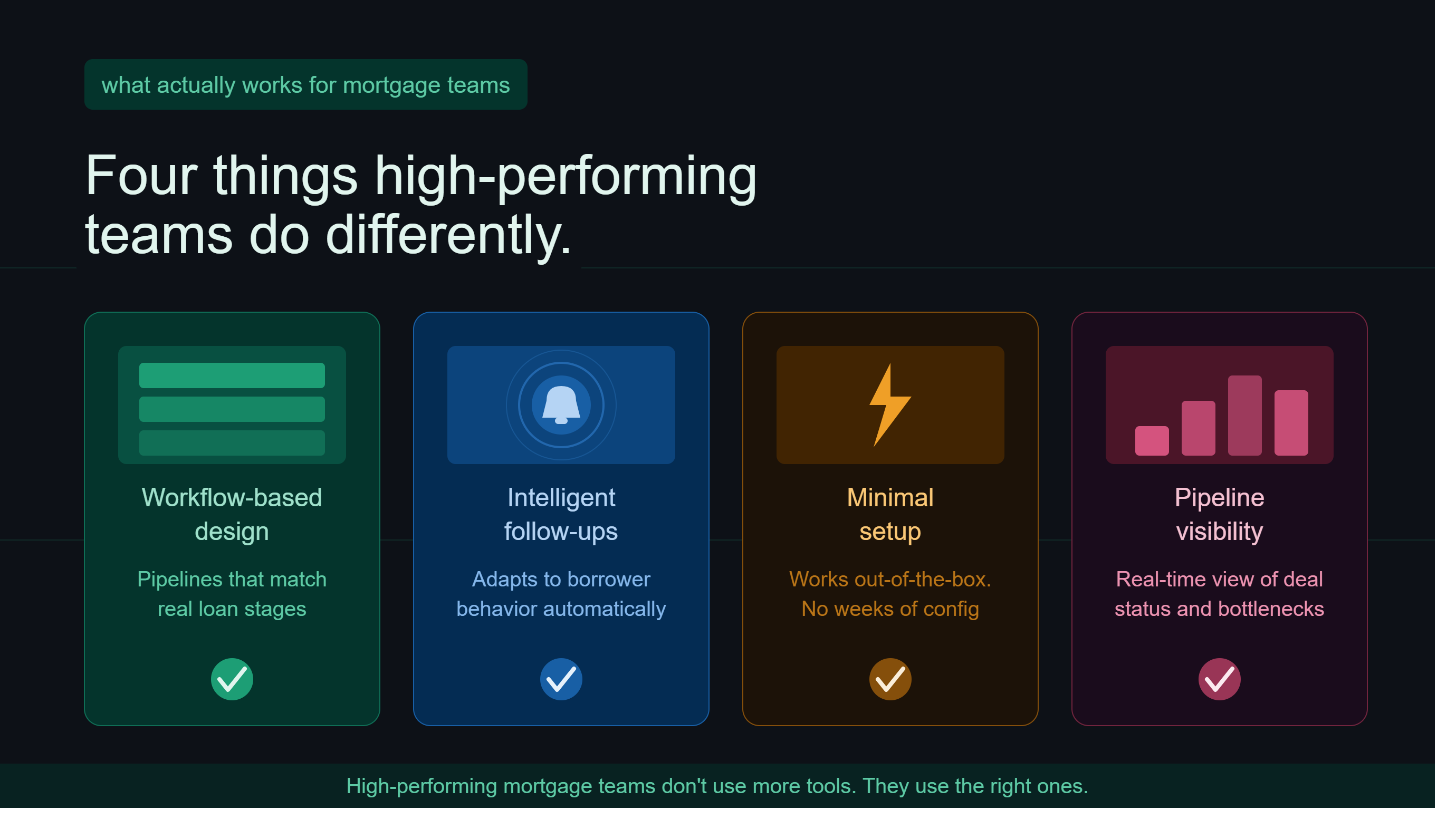
Instead of forcing general tools to fit, high-performing teams are moving toward systems designed specifically for their workflow.
The most effective systems focus on:
✔️ Workflow-Based Design
Pipelines that reflect real loan stages, not generic sales funnels
✔️ Intelligent Follow-Ups
Automation that adapts based on borrower behavior and deal stage
✔️ Minimal Setup
Tools that work out-of-the-box without weeks of configuration
✔️ Clear Pipeline Visibility
Real-time insight into deal status, next steps, and bottlenecks
The Shift Toward AI-Powered Mortgage CRM
A new generation of CRM platforms is emerging, focused on automation and workflow intelligence.
These systems aim to:
·
Reduce manual data entry
·
Improve response times
·
Ensure consistent follow-ups
· Help loan officers focus on closing, not admin work
Instead of acting as a database, the CRM becomes an active system that supports daily execution.
A Smarter Approach to CRM
Modern mortgage teams are starting to prioritize:
·
Simplicity over complexity
·
Automation over manual tracking
· Workflow alignment over heavy customization
Platforms designed with this approach focus on:
·
Loan-stage-based pipelines
·
Automated follow-ups
· Faster onboarding
This is especially useful for:
·
High-volume loan officers
·
Growing mortgage teams
· Businesses looking to scale without adding operational overhead
How to Choose the Right Mortgage CRM
Before selecting a CRM, ask:
1.
Does it match how my loan process actually
works?
2.
How much setup is required before I can use it?
3.
Does it help me follow up faster and more
consistently?
4. Will it reduce my workload, or add to it?
The right CRM should simplify your workflow, not complicate it.
Final Thoughts
Most CRM problems in the mortgage industry don’t come from lack of features.
They come from misalignment with how loan officers actually work.
The shift is clear:
👉 From
flexible but complex systems
👉 To workflow-driven, automation-first platforms
Because in
mortgage, success isn’t about having more tools,
It’s about having the right system that helps you close more deals.
Want a CRM That Actually Fits Mortgage Workflows?
If you’re evaluating CRM options, it’s worth exploring platforms designed specifically for loan officers — with built-in workflows, automation, and minimal setup.
Moserbus is one such platform built around how mortgage teams actually operate.
FAQs
What is the best CRM for loan officers?
The best CRM for loan officers is one that aligns with mortgage workflows, automates follow-ups, and requires minimal setup.
Why do traditional CRMs fail mortgage teams?
They are designed for general sales processes and often require heavy customization to fit mortgage-specific workflows.
What features should a mortgage CRM have?
Key features include workflow-based pipelines, automation, follow-up tracking, and real-time visibility into deal stages.
Do I need an AI-powered CRM for mortgage?
AI-powered CRMs can help automate follow-ups, improve response times, and reduce manual work, making them increasingly valuable.