HubSpot vs. Salesforce for Mortgage Lenders: Which CRM Wins in 2026?
"HubSpot vs Salesforce" is the search every mortgage broker eventually runs, and every result gives the same generic SaaS answer: HubSpot for ease, Salesforce for power. None of it mentions 1003 forms, loan stages, or what happens when a borrower doesn't hear back in four hours. This breakdown covers real 2026 pricing for both platforms in a mortgage context HubSpot's split Sales Hub/Marketing Hub invoices, Salesforce's Jungo-plus-implementation reality and makes the case that the actual choice isn't between two generalist CRMs at all.
A mortgage-native platform like MoserBus skips the retrofitting entirely: loan stages, 1003 handling, and compliance-aware texting exist from the first login instead of getting bolted on by an admin six months into a Salesforce build.
Search "HubSpot vs Salesforce" and you'll get the same comparison every SaaS blog has run for a decade: HubSpot for ease of use, Salesforce for customization, pick your poison. None of it mentions loan stages, 1003 forms, or the fact that a borrower who doesn't hear back in four hours will have three competing rate quotes by lunch.
That's the real question a loan officer or broker owner is asking when they type this into Google. Not "which CRM has better email tracking," but "which one keeps my pipeline moving without me hiring someone just to run the software."
Short answer: neither wins outright, and treating this as a two-horse race is where a lot of mortgage teams go wrong. Both are excellent products for the customers they were designed around, sales and marketing teams in SaaS, retail, and general B2B. Mortgage lending is none of those things, and the gap shows up fast once a loan actually enters underwriting. Here's what HubSpot and Salesforce pricing and features actually look like for a lending shop in 2026, and where the real decision sits.
Why This Comparison Gets Complicated for Mortgage Teams
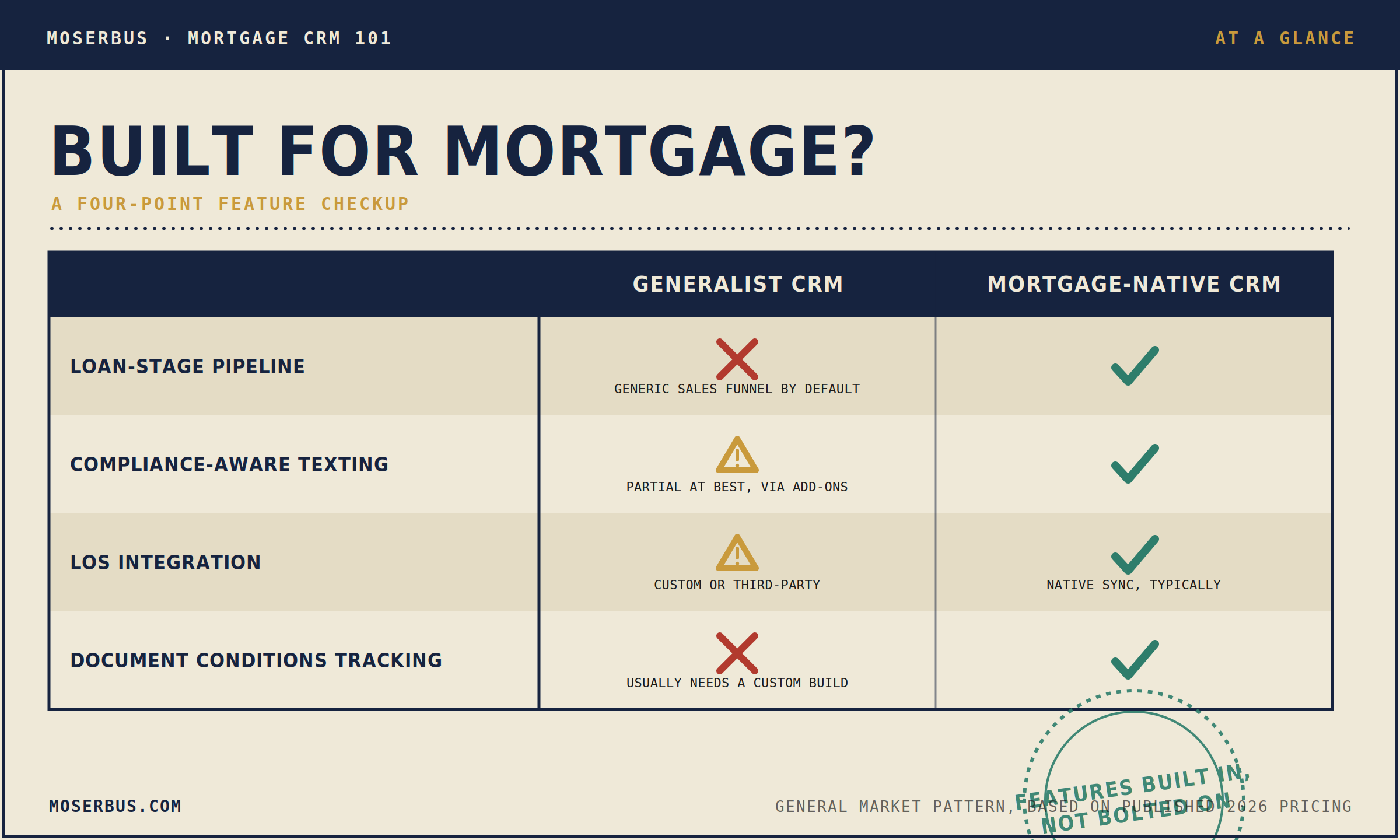
HubSpot and Salesforce were both built to sell CRM software, not mortgages. Every "best CRM software" listicle treats every industry the same way, and mortgage isn't like every industry. The default pipeline in both tools is a generic sales funnel: lead, qualified, proposal, closed-won. A mortgage deal doesn't move like that. It moves through pre-approval, document collection, underwriting, conditional approval, and closing, and each stage carries its own compliance requirements and its own follow-up clock.
Traditional CRMs fail loan officers for exactly this reason. The pipeline structure doesn't match the loan, so teams end up building custom fields and workarounds just to see where a file actually stands. That's the starting point for both HubSpot and Salesforce in mortgage: flexible, general-purpose software that a lending team has to bend into shape before it's useful.
HubSpot for Mortgage Lenders: What You Actually Get
HubSpot's strengths are real. Email tracking, pipeline visualization, and reporting are genuinely well built, and it's one of the easier CRMs on the market to onboard a new hire into. If your brokerage already runs marketing, sales, and support on HubSpot, adding mortgage on top has a shorter learning curve than starting from zero with something unfamiliar.
HubSpot pricing for Sales Hub in 2026 breaks down roughly like this:
- Free CRM: usable, but capped at one pipeline with no automation.
- Starter: around $15–20 per seat/month, adds basic automation and multiple pipelines.
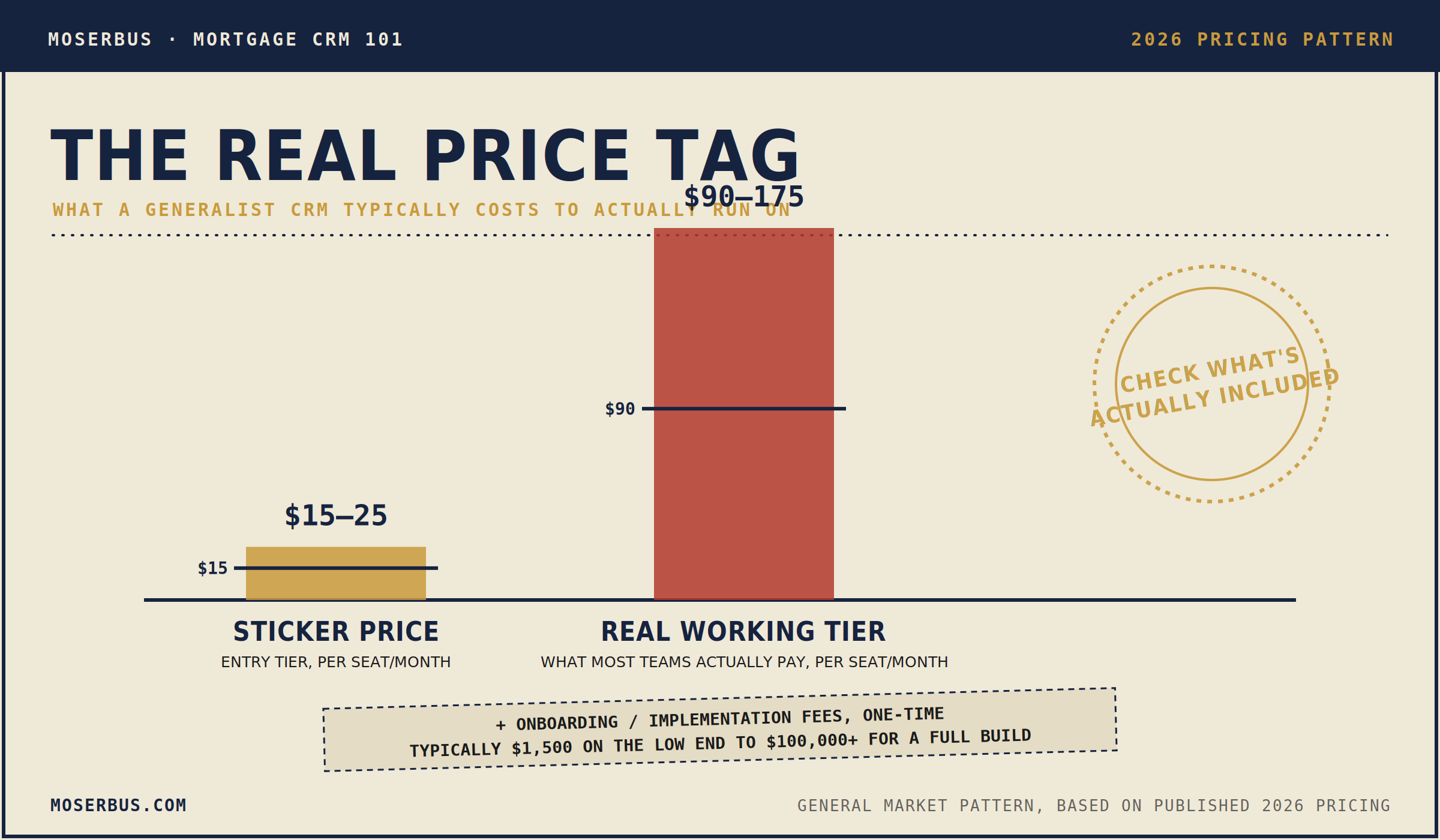
- Professional: roughly $90–100 per seat/month, plus a mandatory one-time $1,500 onboarding fee. Sequences, custom reporting, and lead scoring live here.
- Enterprise: around $150 per seat/month, plus a $3,500 onboarding fee.
That's Sales Hub alone. Want the marketing automation half, drip campaigns, lead nurture, landing pages? That's a separate Marketing Hub subscription, and its Professional tier starts near $890/month on its own. Two hubs, two invoices, and a lot of mortgage teams don't find that out until the demo call.
Here's where it breaks down for the actual job: HubSpot has no concept of a loan stage. There's no native compliance-aware texting for TRID- and RESPA-regulated communication, no document conditions tracking, and no loan origination system sync out of the box. A recent MoserBus ranking of the top mortgage CRM software put it plainly: HubSpot is excellent software built for the wrong industry. You can push it toward mortgage with custom fields and third-party integrations, but you're paying real money and real setup hours to teach a generalist tool what "clear to close" means.
Salesforce for Mortgage Lenders: The Power and the Price Tag
Salesforce is the platform most large lenders eventually get pitched, for a real reason. Financial Services Cloud is deep, the AppExchange ecosystem is enormous, and with enough IT budget, you can build almost anything on top of it.
2026 Sales Cloud pricing, per user per month, billed annually except Starter:
- Starter Suite: $25
- Pro Suite: $100
- Enterprise: $175
- Unlimited: $350
- Agentforce 1 Sales (full AI suite): $550
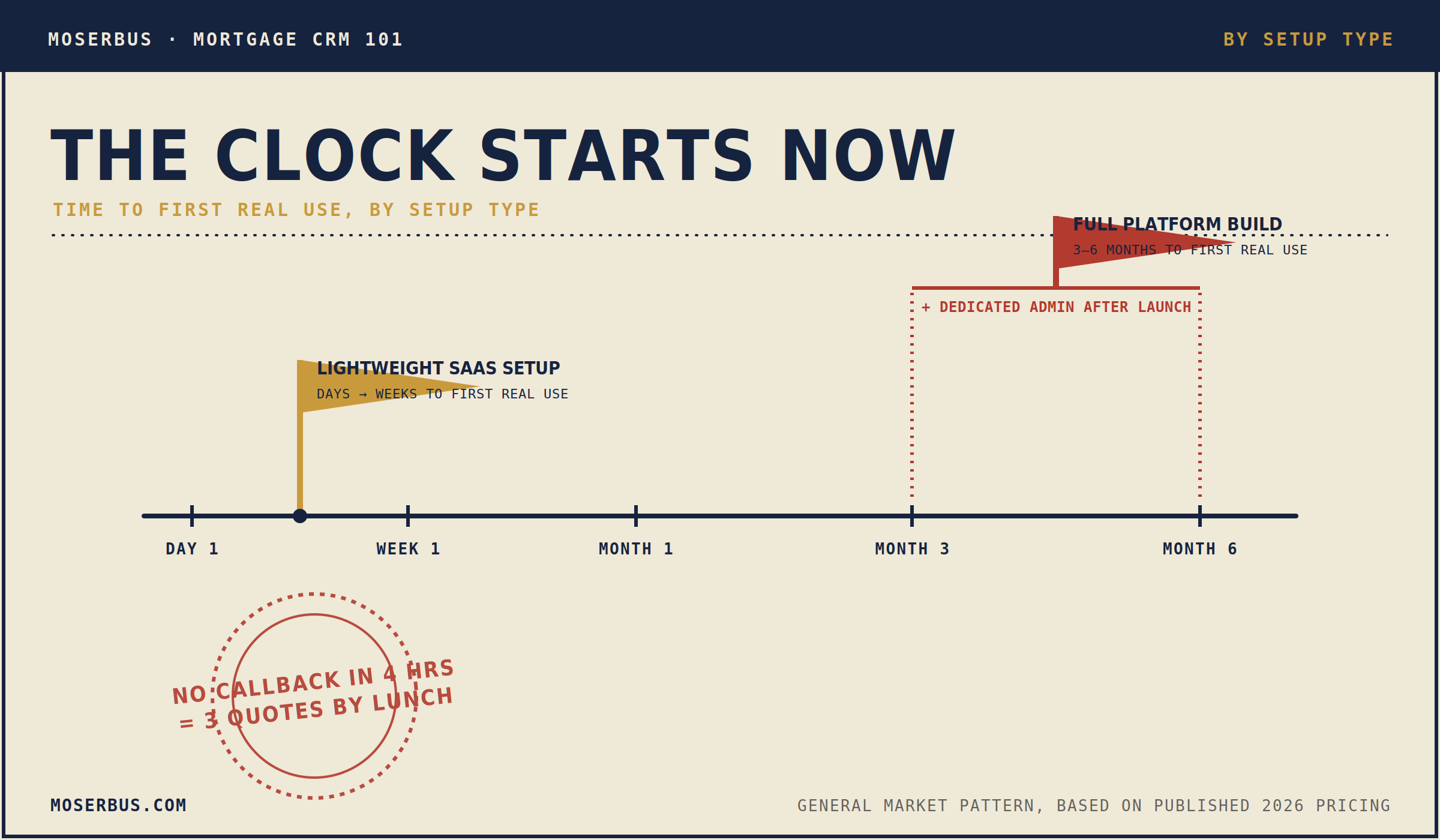
Those numbers look almost reasonable next to HubSpot's Enterprise tier until implementation enters the picture. Salesforce isn't a product you switch on, it's a project. For a mortgage-specific build, that usually means Jungo or a similar mortgage layer stacked on top of the base license, plus custom objects for loan files, borrower stages, and compliance logging that don't exist by default. A full breakdown of what Salesforce implementation actually costs puts a proper mortgage build anywhere from the low tens of thousands into six figures, on a three- to six-month timeline, with a dedicated admin needed once it's live. Larger shops also now have to plan around Salesforce's 2026 MFA enforcement rollout, one more line item for whoever owns the org.
None of that makes Salesforce a bad product. It makes it sized for a different kind of company than most independent brokerages and small to mid-size lending teams.
HubSpot vs. Salesforce: Side by Side for Mortgage Teams
|
HubSpot |
Salesforce |
|
|
Entry price |
Free, then $15–20/seat |
Free (2 users), then $25/seat |
|
Real working tier |
~$100/seat + $1,500 onboarding |
~$175/seat + implementation project |
|
Mortgage-native pipeline |
No |
No, needs Jungo or similar |
|
Compliance-aware texting |
No |
Partial, via add-ons |
|
LOS integration |
Custom/third-party |
Custom/third-party |
|
Time to first real use |
Days to weeks |
Months |
|
Best fit |
Teams already standardized on HubSpot |
Large lenders with dedicated IT/admin resources |
Why Brokers Keep Paying for the Wrong Fit
If either platform is this mismatched, why do so many brokerages still run their whole pipeline through one of them? Mostly because the switching cost feels bigger than the daily cost of staying. A team that's already spent three months migrating borrower data and training loan officers on Salesforce doesn't want to hear that the tool is part of the problem. Sunk time gets mistaken for sunk value.
The catch is that the daily cost doesn't show up on an invoice, it shows up in the pipeline. A loan officer who has to open a second tab to check document conditions, or manually remember that a file moved to "clear to close," is losing small amounts of time dozens of times a day. None of it feels urgent in the moment. All of it adds up to slower response times, and slower response times are exactly what sends a borrower to a competitor who called back first.
The Real Question Isn't HubSpot vs. Salesforce
Here's what most comparisons skip: framing this as a two-way fight assumes the winner has to be one of these two. For a mortgage-specific workflow, that assumption is the actual problem. Both platforms were built for generic B2B sales teams first, and mortgage got retrofitted on afterward, by you, your admin, or an implementation partner billing by the hour.
A mortgage CRM built specifically for loan officers closes that gap from the other direction. Instead of configuring loan logic on top of a sales platform, 1003 handling, document workflows, and stage-based follow-ups exist from the first login. MoserBus runs on that model: an AI chatbot that takes real action, creating a borrower, drafting a follow-up text, pulling loan status, instead of just answering FAQs, plus a built-in power dialer and an automated marketing engine timed to mortgage stages rather than a generic drip sequence borrowed from SaaS sales. The full picture is in this walkthrough of what mortgage-native software actually saves a broker.
If you're already comparing Salesforce alternatives specifically to skip a six-figure implementation bill, this is the category worth fifteen minutes of your time before you sign anything.
When HubSpot or Salesforce Actually Makes Sense
To be fair to both: if your brokerage is one department inside a company already standardized on HubSpot across marketing, sales, and support, staying put and configuring around it often beats running a second system. And a large multi-branch lender with dedicated IT, deep cross-department integration needs, and budget to match genuinely gets value from Salesforce's flexibility that a smaller shop never will.
The mistake isn't choosing HubSpot or Salesforce. It's choosing either one by default because everyone's heard of them, then finding out eighteen months in that a loan officer still needs three extra clicks to log a call the system was never built to understand. Brand recognition isn't the same thing as fit, and in mortgage, fit is what shows up in your close rate.
FAQs
Is HubSpot or Salesforce better for mortgage brokers? Neither is purpose-built for mortgage. HubSpot is easier to set up and cheaper at entry, but lacks loan-stage logic and compliance-aware texting. Salesforce is more customizable but needs a mortgage layer like Jungo and a real implementation budget. A mortgage CRM built for loan officers typically fits faster and cheaper than either for independent brokers and small to mid-size lending teams.
How much does Salesforce cost for a mortgage company? License pricing runs $25 to $550 per user/month depending on edition. A proper mortgage-specific implementation, license plus a mortgage layer, custom objects, and setup, commonly runs from the low tens of thousands into six figures, plus ongoing admin costs after launch.
How much does HubSpot cost for a mortgage team? Sales Hub alone runs free to roughly $150 per seat/month, plus onboarding fees at the higher tiers. Marketing Hub, needed for real automation and lead nurture, is a separate subscription that starts near $890/month at the Professional tier.
Is there a CRM built specifically for mortgage loan officers? Yes. Mortgage-native platforms like MoserBus start with loan stages, 1003 handling, and compliance-aware communication already built in, instead of requiring configuration on top of a generic sales CRM.
Can I integrate HubSpot or Salesforce with my loan origination system? Both can connect to most LOS platforms through custom integrations or connectors like Zapier, but neither has native LOS sync the way a purpose-built mortgage CRM typically does.
Will switching CRMs disrupt an active pipeline? Any migration carries some risk, which is why most brokers switch between funding seasons rather than mid-quarter. A mortgage-native platform with minimal setup, rather than a months-long Salesforce build, shrinks that disruption window considerably since there's no parallel configuration project running while loan officers keep working live files.
If your team is stuck picking between two platforms that were never built for mortgage in the first place, schedule a MoserBus demo and bring your actual pipeline. Thirty minutes will tell you more than any feature comparison chart.