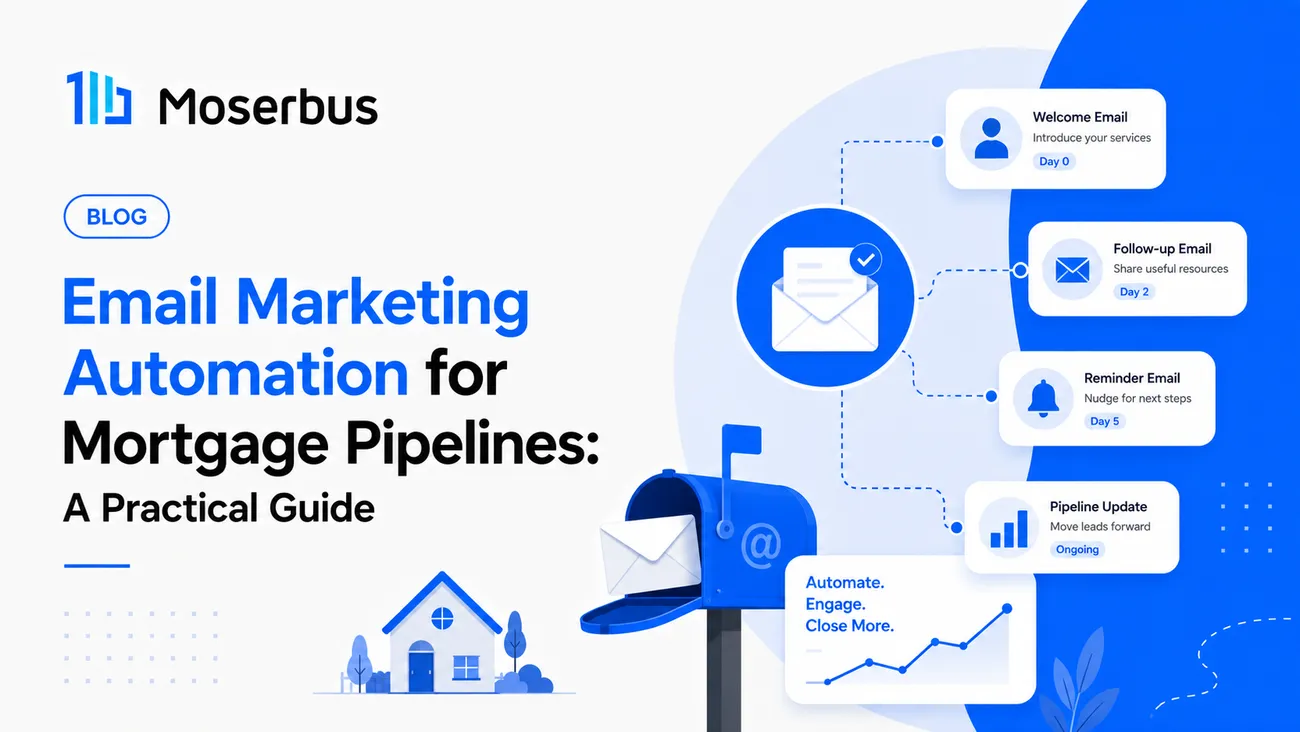
Email Marketing Automation for Mortgage Pipelines: A Practical Guide
Most mortgage pipelines don't lose deals to rate shopping, they lose them to silence. This guide breaks down how email marketing automation actually works when it's built around a real loan pipeline instead of a generic drip campaign: which pipeline stage should trigger which email, how to structure a first sequence across purchase, refinance, and realtor segments, and where automation turns into spam if it's not tied to actual file status.
It also covers the behavioral reason manual follow-up fails at scale, what a working mortgage lead nurturing sequence looks like stage by stage, and how MoserBus ties automated email sequences directly to pipeline changes so nothing depends on a loan officer remembering to hit send.
A borrower fills out a pre-approval form at 9 p.m. on a Tuesday. She's excited, checking her inbox every twenty minutes. By Thursday, nothing. The loan officer meant to follow up, but three other files caught fire that week. By the time he calls Friday afternoon, she's already pre-approved with someone else who emailed her the next morning.
That's not a lead generation problem. It's a lead nurturing problem, and it's the single most common way mortgage pipelines leak revenue. Email marketing automation is the fix, but most loan officers either skip it entirely or set up a generic "welcome series" that has nothing to do with where a borrower actually sits in the pipeline.
Here's what it looks like when built around a real mortgage pipeline instead of bolted onto a generic newsletter tool, and how to set one up without turning your inbox into a spam machine.

What Email Marketing Automation Actually Means for a Loan Pipeline
Email marketing automation is the practice of sending pre-written emails automatically, triggered by a borrower's stage in the pipeline rather than by a person remembering to hit send. The pre-approval confirmation, the "we're missing your bank statements" nudge, the underwriting update: each one fires the moment a file's status changes, not whenever the loan officer gets a free minute.
That distinction matters more in mortgage than almost any other industry. A generic email platform sends based on time delays: three days after signup, send email two. A mortgage pipeline doesn't move on a schedule. One file clears underwriting in four days; another sits for three weeks waiting on an appraisal. If your automation only knows how to count days, it starts sending "still waiting on your documents" emails to a borrower who submitted everything last week. That's worse than no automation at all.
This is one reason generic CRMs built for other industries tend to fall apart for loan officers: they weren't built with loan stages as the trigger. Pipeline-aware automation solves that by watching the same status field the loan officer already updates, and firing email content off it.
Benefits of Email Marketing Automation for Mortgage Pipelines
Setting this up isn't just about saving time on typing emails. For a mortgage pipeline specifically, the payoff shows up in a few concrete places:
- Borrowers hear from you the moment their file changes status, not whenever a loan officer remembers to check in, so trust builds instead of eroding during slow stretches like underwriting.
- Lead nurturing runs in the background across every open file at once, which matters when one loan officer is juggling forty or more borrowers moving through the pipeline at different speeds.
- Realtor and referral partners get looped into deal status automatically, which tends to translate into more repeat business without adding extra calls to a loan officer's day.
- Compliance-relevant communication goes out on a consistent schedule instead of depending on memory, which lowers the odds of a documentation gap surfacing during an audit.
- Loan officers spend less time on repetitive status updates and more time on the borrowers who actually need a phone call, like someone stuck on a stipulation or nervous about a rate lock.
None of this replaces a loan officer's judgment. It just makes sure the routine parts of the mortgage pipeline don't depend on someone remembering to handle them.

Why Manual Follow-Up Is Where Mortgage Deals Quietly Die
Borrowers rarely leave because they got a bad rate. They leave because they stopped hearing from you and started hearing from someone else. Behavioral researchers call this recency bias: people weight whoever contacted them most recently as the most trustworthy and attentive option, regardless of who reached out first. A borrower who applies with two lenders on the same day will usually go with whichever one keeps showing up.
Loan officers know this. It's why the number one reason loan officers lose deals comes down to follow-up gaps rather than pricing. The problem isn't a lack of care. It's that a person managing forty active files cannot mentally track when file twenty-three needs its next touch. Automation doesn't need to remember. It just needs the trigger.
Mapping Automated Emails to Every Stage of the Pipeline
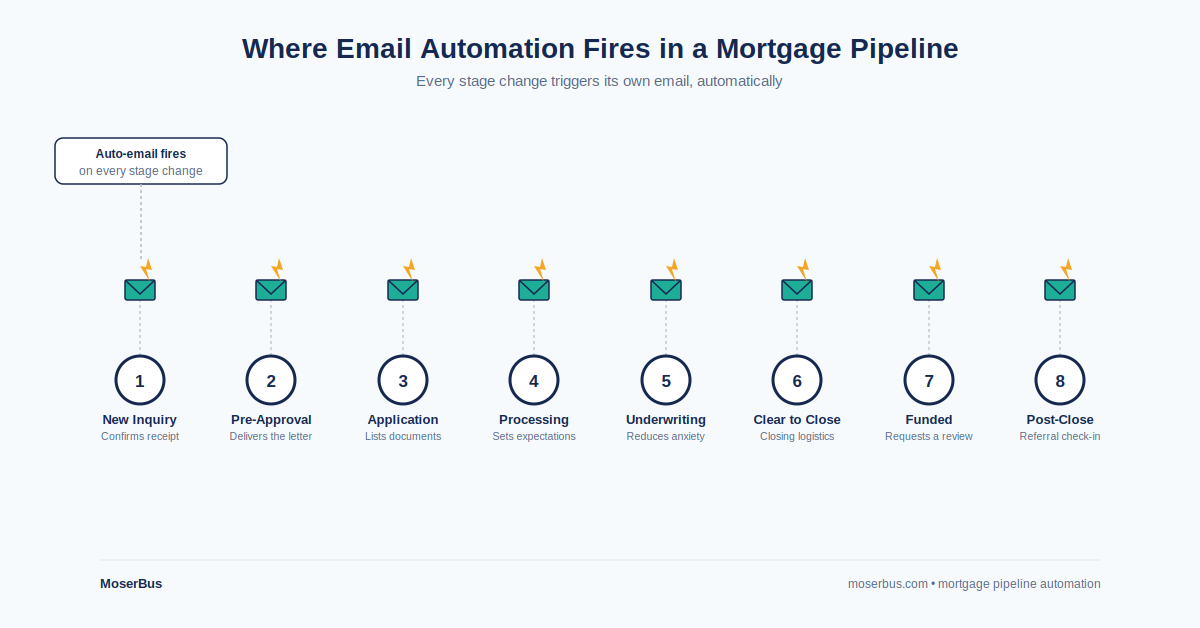
The biggest mistake in mortgage email automation is writing one drip campaign for "new leads" and calling it done. A pipeline has distinct stages, and each one needs its own message, tone, and urgency level.
|
Pipeline Stage |
Trigger |
What the Email Should Do |
|
New Inquiry |
Lead submitted or captured |
Confirm receipt, set expectations for next steps and timeline |
|
Pre-Approval Issued |
Status change to "pre-approved" |
Deliver the letter, explain what to do with it, invite questions |
|
Application Submitted |
Full application received |
Confirm receipt, list any missing documents by name |
|
In Processing |
Status change to "processing" |
Explain what happens next and roughly how long it takes |
|
Underwriting |
Status change to "underwriting" |
Set expectations on turnaround, reduce anxiety about the wait |
|
Clear to Close |
Conditions cleared |
Walk through closing day logistics, final numbers, what to bring |
|
Funded / Closed |
Loan funded |
Thank the client, ask for a review, plant the referral seed |
|
Post-Close |
30/60/90 days after closing |
Check in, share rate-drop alerts, stay top-of-mind for referrals |
Each row is its own short sequence, not a single email. A borrower in underwriting doesn't need a sales pitch, they need reassurance that the silence is normal. A borrower who just closed doesn't need a sales pitch either, they need a reason to send you their sister.
Building Your First Mortgage Drip Campaign
An email drip campaign, in plain terms, is a short series of emails that go out automatically over time or based on triggers. Building one for a mortgage pipeline is more about structure than writing talent.
1. Segment before writing a single email. Purchase buyers, refinance leads, and realtor referral partners need different messages even at the same pipeline stage, and lumping them into one sequence is the fastest way to sound irrelevant.
2. Map one trigger per stage. Go back to the pipeline stages your CRM already tracks and assign each one an email instead of a delay. If the CRM can't expose stage changes as a trigger, that's a tooling problem worth fixing first.
3. Keep each track short. Five to seven emails is usually enough; longer sequences see open rates drop off, and shorter ones don't build enough familiarity to matter.
4. Set cadence to match how the stage actually moves, not a fixed schedule. Pre-approval to application might take a day or two, while underwriting can stretch for weeks, and a generic "day 3" template ignores that difference.
5. Test subject lines against open rates before scaling further. Mortgage borrowers tend to open emails with their name, loan amount, or property address in the subject line at noticeably higher rates than something generic like "Your Update."
The Segments That Actually Move the Needle
Not all mortgage leads behave the same way, and treating them like one list is where most nurturing sequences fall flat. Purchase buyers are usually anxious about timelines: will they close before their lease ends, will the appraisal come in high enough, what happens if rates move before lock. Their emails should lean into education and reassurance.
Refinance leads care about one thing most of the time: is this still worth it. A rate-drop alert email, sent automatically when your system detects their target rate, converts far better than a generic monthly newsletter.
Realtor and referral partners are a different animal entirely. They don't want borrower-style hand-holding; they want deal status updates they can relay to their own client without having to call and ask. A separate automated track that pings them at the same trigger points (application in, conditions cleared, funded) keeps them looped in without extra work on your end. This is also where choosing the right mortgage CRM actually shows up in referral volume, since a system built to loop in third parties automatically tends to keep more realtors sending business back.
Where Automation Turns Into Spam
Automation earns its reputation as annoying when it's set up carelessly. A few patterns to avoid:
Sending the same message to every segment regardless of loan type or stage is the fastest way to feel like a mass blast rather than a personal update. Letting automation run on a timer instead of on pipeline status is the second most common failure. Nothing erodes trust faster than a "we're still waiting on your paperwork" email that lands after the borrower already sent it in. And stripping every trace of a personal touch out of milestone moments, especially clear-to-close and funding, makes automation feel like it's replacing the loan officer rather than supporting them. The email can be templated; it still needs to read like it came from a person who knows the file.
Compliance is worth a mention here too. Mortgage communication sits under rules that generic marketing tools don't account for: timing around disclosures, required language, and recordkeeping expectations vary by state and loan type. Automation should make it easier to stay consistent with those requirements, not create a new channel that compliance has never reviewed.
Where MoserBus Fits Into This
This is exactly the gap MoserBus's automated marketing engine was built to close. Drip campaigns run through a built-in SendGrid integration, but they're triggered by the same custom pipeline stages a loan officer already manages, not a generic timer. When a file moves from processing to underwriting, the underwriting-stage email fires automatically, without anyone opening a separate email tool.
For loan officers who don't want to write five email tracks from scratch, the AI template generator drafts email, SMS, and voicemail content in seconds, which cuts the setup time on a full pipeline automation down from a week to an afternoon. Pair that with visual workflow management that shows exactly where every file sits, and the automation stays synced to reality instead of drifting into the generic-timer problem described above.
If your current setup can't tell the difference between a pre-approval and a post-close email, it's worth a look at what a proper loan origination system should handle versus what belongs in the CRM layer. Schedule a demo to see automated pipelines running against your actual loan stages, not a demo dataset.
Frequently Asked Questions
What is email marketing automation for mortgage brokers? It's the use of pre-written emails that send automatically based on a borrower's loan status (pre-approval, processing, underwriting, clear to close) rather than emails a loan officer has to remember to send manually.
How many emails should a mortgage drip campaign include? Most effective tracks run five to seven emails per pipeline stage or segment. Longer sequences see declining open rates; shorter ones don't build enough familiarity to matter.
Can email automation trigger off loan pipeline stage instead of just time delays? Yes, and it should. Automation tied to actual pipeline status avoids sending outdated messages when a file moves faster or slower than a fixed schedule assumes.
Is email automation different from a mortgage CRM? A CRM handles sales pipeline management: it stores borrower data and tracks where each file sits. Email automation acts on that data. The two work best combined, where pipeline status changes inside the CRM directly trigger the next email in the sequence.
Does mortgage email automation need to account for compliance? Yes. Timing around disclosures and required communication language varies by loan type and state, so any automated sequence should be reviewed against your compliance requirements before it goes live.
If your follow-up depends on someone remembering to send it, it isn't automation yet. It's a to-do list with extra steps. Explore MoserBus's pipeline-based automation or get started and connect it to your first loan file today.