Current Mortgage Rates This Week: What Loan Officers Need to Know
Rates read differently depending on which tracker you check this week, and that gap alone is worth explaining to a borrower. This post breaks down where the 30-year fixed actually sits as of August 3, 2026, why a hawkish Fed dissent and an oil price spike pushed rates higher through July, and what the MBA's weekly application data says about how borrowers are reacting in real time.
It also gets specific about talking points: which borrowers deserve a call this week, how to frame the "should I wait" question with real payment numbers instead of vague reassurance, and what the August 12 CPI report and September's FOMC meeting could mean for the rest of 2026. Built for loan officers who already track this stuff and want the reasoning behind the number, not another rate recap.
Mortgage rates today: 6.78% on Bankrate's survey this morning, August 3, versus 6.65% on Zillow's. That 13-basis-point gap between two trackers is one most borrowers will never notice, and every loan officer needs to be ready to explain, because "current mortgage rates" was never one number to begin with. It's a moving target that depends on which lender panel, which credit tier, and which minute of the day you're looking at.
Here's where things actually stand this week, why they got here, and what to say to the borrower who read a headline last night and is now on the phone with questions.
Where mortgage rates stand this week
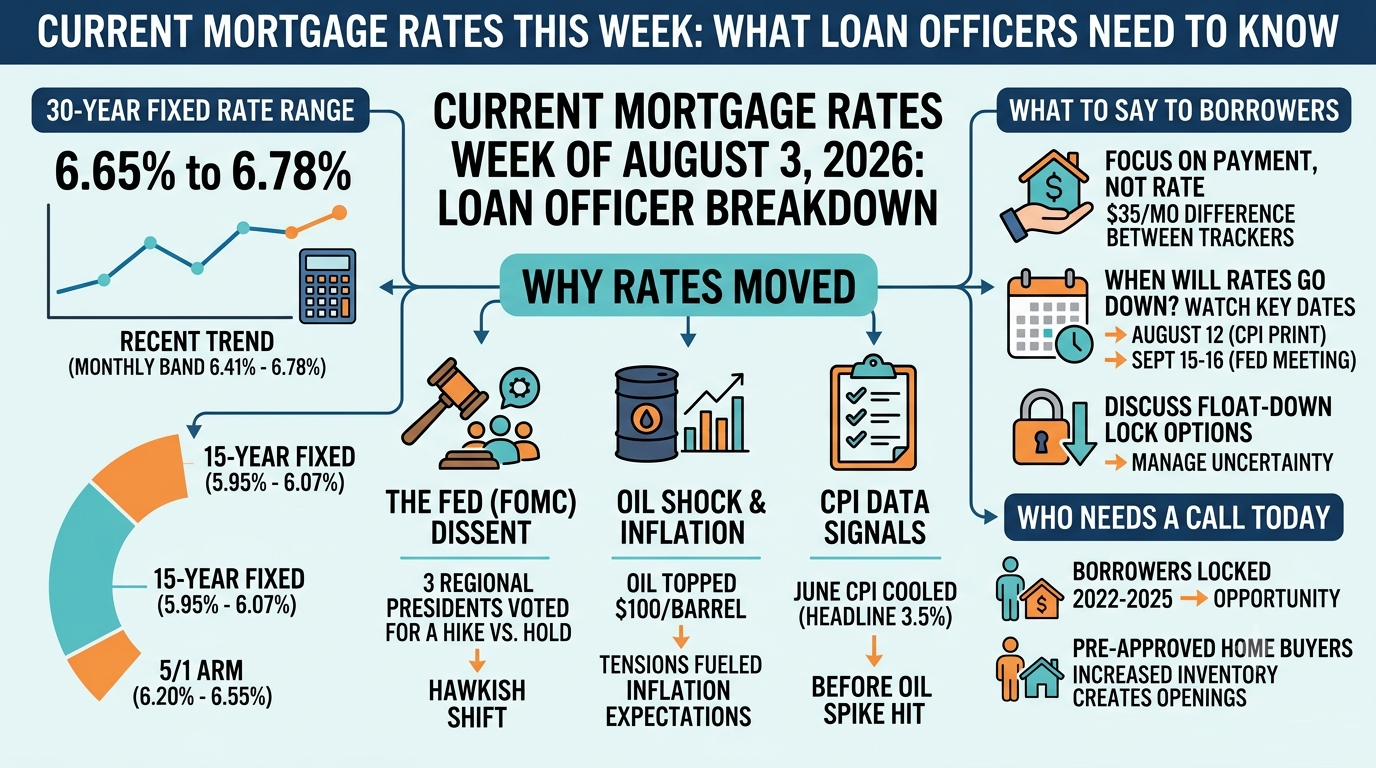
As of the week of August 3, 2026, the range across major trackers looks like this:
- 30-year fixed: 6.65% to 6.78% (Zillow vs. Bankrate)
- 15-year fixed: 5.95% to 6.07%
- 5/1 ARM: 6.20% to 6.55%
- 30-year refinance: 6.84% to 6.97%
For context, the 30-year fixed has traded in a 6.41% to 6.78% band over the past month. That's well below its 52-week high of 6.92%, hit in May 2025, but nowhere near its 52-week low of 5.90%, set in late February this year. On a $400,000 loan, the gap between this week's 6.78% and February's low works out to roughly $230 a month in principal and interest. That's the number that actually changes a borrower's decision, more than the headline rate ever does.
If a client's confused about why your rate sheet doesn't match what they found on Zillow at 11pm, that's normal and worth saying out loud. Aggregator averages reflect a blended panel of lenders, not a single locked quote, and they rarely match wholesale or retail pricing on any given morning.
Why rates moved: the Fed, an oil shock, and a hawkish dissent
Understanding the mortgage rate trends behind this move matters more than memorizing today's number, because rates didn't drift up in July by accident. Three things are doing the work right now.
First, the Fed. The FOMC held its benchmark rate at 3.50% to 3.75% at its July 28 to 29 meeting, Chair Kevin Warsh's second meeting since taking over. What stood out wasn't the hold. It was the dissent: three regional presidents voted against it, all wanting a hike instead, the most hawkish split the committee has seen since September 2016. That tells you the committee's center of gravity has shifted toward worrying about inflation and away from worrying about growth, which matters if you're trying to guess the next move.
Second, oil. Prices pushed past $100 a barrel as tensions between the U.S. and Iran escalated, and that's feeding straight into inflation expectations. Mortgage rates price off the 10-year Treasury yield plus the spread that mortgage-backed securities investors demand on top of it, and that spread widens whenever investors expect inflation to stay sticky. The 10-year moved to roughly 4.66% the day of the Fed decision.
Third, the underlying data has been a mixed signal. June's CPI report, released July 14, actually cooled: headline inflation fell 0.4% month over month and landed at 3.5% year over year, down from May's 4.2%. Core CPI ran 2.6% year over year, real progress by any measure. But that report landed before the oil spike fully hit the numbers. July's CPI, due August 12, is the one that tells us whether the cooling holds or reverses.
What this means for your pipeline right now
The MBA's weekly applications survey is the closest thing to a real-time read on borrower behavior, and the last few weeks tell a story worth knowing before your next call.
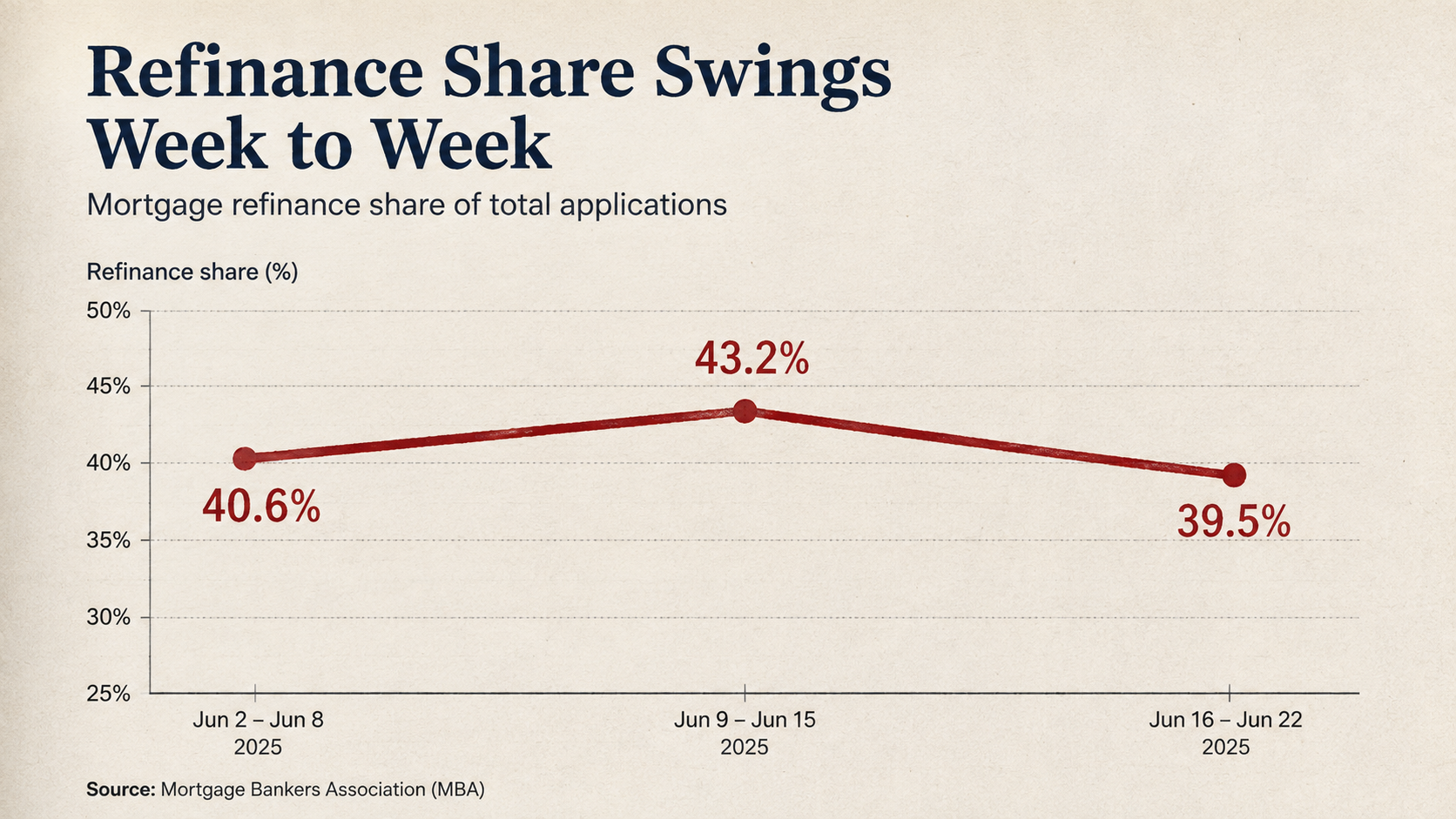
For the week ending July 24, total applications fell 6.4% as the 30-year conforming rate climbed to 6.76%, its highest level since August 2025. Refinance applications alone dropped 10% that week. The week before, applications had actually risen 1.9% even with rates at 6.69%, purchase activity up 6%, because rising inventory in a lot of markets is giving buyers room to act even at these levels. Refinance share of total activity swung from 40.6% to 43.2% to 39.5% inside of three weeks, proof that refi borrowers are watching rates day to day and moving fast the moment a window opens, even a narrow one.
Demand didn't disappear. Borrowers just got more reactive to small rate moves than they were a year ago, and that raises the cost of a slow follow-up. A lead who goes quiet for 48 hours during a week like this one might resurface the moment rates tick down, and if a competitor answered the phone first, that lead is gone for good. We've written before about how the most common way loan officers lose deals has less to do with rate and more to do with response time. A volatile week like this one is exactly where that gap shows up.
Which borrowers deserve a call today
Not every borrower in your pipeline needs to hear from you this week, but two groups do.
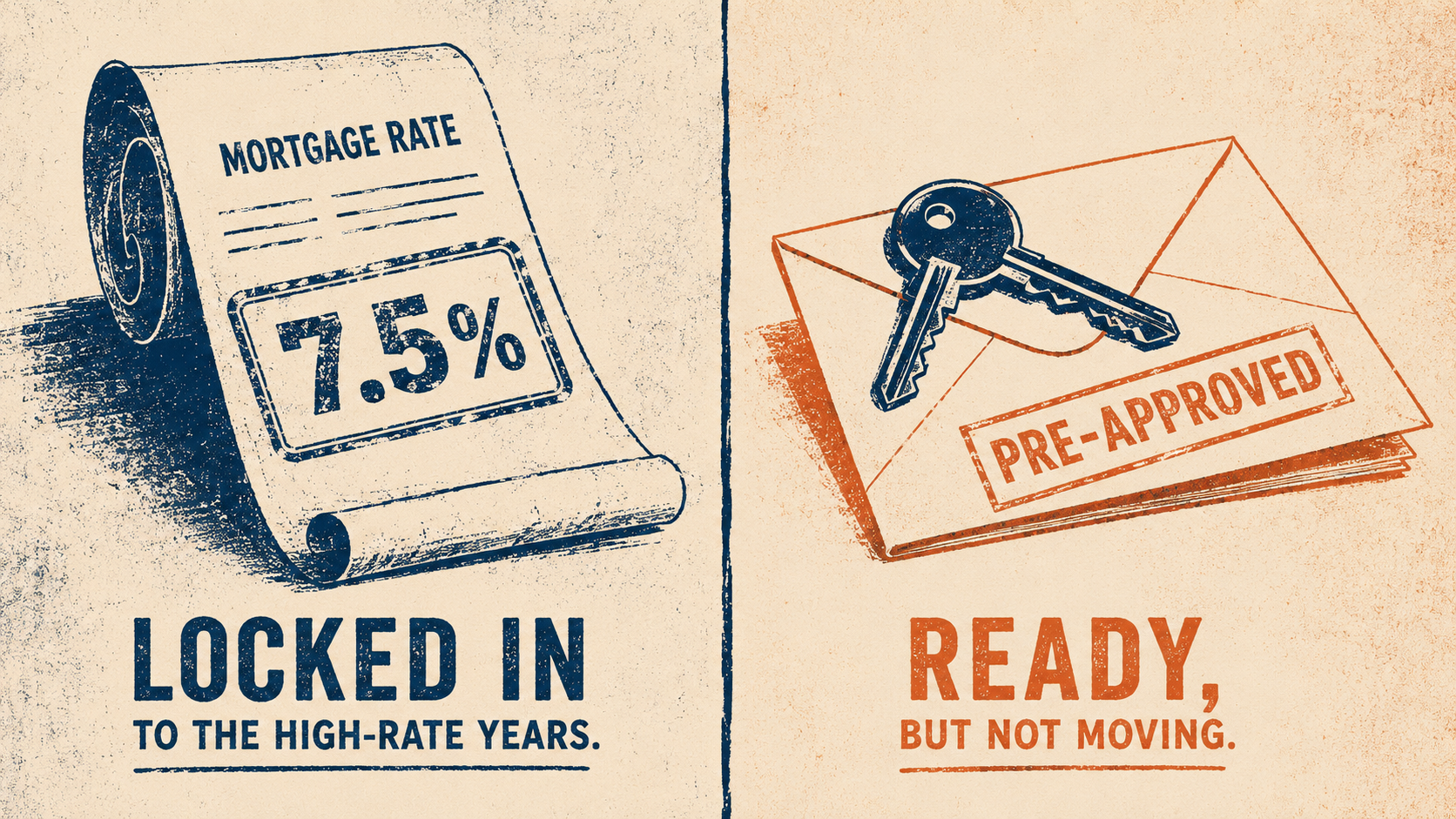
The first is anyone who locked or bought between 2022 and mid-2025, when rates regularly sat above 7.25% and occasionally touched 8%. Even at this week's 6.65% to 6.78%, that's a meaningful spread, and a lot of those homeowners have no idea a refinance conversation is worth having again. You don't need a full point of movement to make the call worthwhile for someone sitting at 7.5%.
The second is anyone holding a pre-approval who's been hesitating on inventory. Purchase applications have held up better than refinance activity through this stretch precisely because more listings are giving buyers room to negotiate, even with rates where they are. A buyer who paused in the spring because "rates felt too high" is often more persuadable now than they were three months ago, not because the rate improved, but because the market around it did.
How to talk to borrowers about mortgage rates this week
A few things worth having ready before the phone rings.
Lead with payment, not rate. Most borrowers fixate on the percentage because that's the number in every headline, but the number that actually affects their life is the monthly payment. On a $400,000 loan, the gap between 6.65% and 6.78% runs about $35 a month, real money but not a reason to panic. Reframing around actual dollars usually calms a conversation down faster than any rate explanation.
The "when will mortgage rates go down" question is coming whether you bring it up or not. The honest answer this week is that nobody knows for certain, but the data gives you something better than a guess: two clear catalysts, the August 12 CPI report and the September 15 to 16 FOMC meeting, that will move the needle one way or the other. Telling a borrower exactly what to watch and what happens under each outcome builds more trust than a vague "rates might come down soon."
Bring up mortgage rate lock options with a float-down provision where your lender offers one. In a week where rates could move either direction depending on the next inflation print, a lock with a float-down gives an anxious borrower a way to say yes now without feeling like they're betting against themselves.
What to watch next
Three dates matter more than any others between now and Labor Day: August 7 for the July jobs report, August 12 for July's CPI print, and September 15 to 16 for the next FOMC meeting, which comes with a fresh Summary of Economic Projections. A cooler CPI reading in August gives the Fed room to soften its language ahead of September. A hotter one, especially with oil still above $100, makes July's hawkish dissent look prescient. MBA and Fannie Mae's mortgage rate forecast for the rest of 2026 currently sits between 6.4% and 6.5% for the 30-year, though both organizations built those numbers before the current oil shock fully played out, and both have already revised expectations twice this year.
Where MoserBus fits into a week like this
None of this is information a borrower can't find on their own. What most borrowers can't do is act on it fast enough, and that's the gap that actually costs loan officers deals. Rate-driven urgency only converts into a closed loan if the follow-up lands inside the window when a borrower is paying attention, not three days later once they've already called someone else.
MoserBus's automated marketing engine can trigger a text or email the moment a lead goes quiet, and the built-in AI assistant can draft a rate-update follow-up in your own voice in seconds instead of the ten minutes it usually takes to write one from scratch. If you're weighing whether your current setup can keep pace with weeks like this one, our breakdown of why traditional CRMs fail loan officers covers exactly where most platforms fall short on speed, and our rankings of the best mortgage CRM software in 2026 walks through what to look for if you're shopping around.
Schedule a demo to see how automated follow-up handles a volatile rate week, or sign up and build your first rate-alert workflow today.
Frequently asked questions
What's the average 30-year mortgage rate this week? As of the week of August 3, 2026, the 30-year fixed rate averages between 6.65% and 6.78% depending on the source, with Bankrate reporting 6.78% and Zillow reporting 6.65%. Rates have traded in a 6.41% to 6.78% range over the past month.
Will mortgage rates go down in 2026? MBA and Fannie Mae both currently forecast the 30-year averaging 6.4% to 6.5% for the rest of 2026, though both forecasts predate the recent oil-driven inflation pressure and could shift after the August 12 CPI report and the September 15 to 16 Fed meeting.
Why did mortgage rates go up in July 2026? Rates climbed as oil prices topped $100 a barrel amid escalating U.S.-Iran tensions, pushing inflation expectations higher even after June's CPI report showed cooling. The Fed's July 29 hold, paired with three dissenting votes favoring a hike, reinforced the more hawkish outlook.
Why does my rate quote differ from what shows up online? Rate aggregators like Zillow and Bankrate report averages across a panel of lenders, not a single locked quote. Actual pricing depends on credit score, loan-to-value ratio, loan type, and the individual lender, which is why two trackers can show a double-digit basis-point gap on the very same day.